Saturday, February 12, 2011

Online Learning

Hydrogen Sulfide:
Hydrogen sulfide is a harmful chemical compound formed by 2 harmless elements: hydrogen and sulfur. Hydrogen sulfide is a colorless, very poisonous, flammable gas with the characteristic foul odor of rotten eggs. It often results from the bacterial breakdown of organic matter in the absence of oxygen, such as in swamps and sewers (anaerobic digestion). It also occurs in volcanic gases, natural gas, and some well waters. The human body produces small amounts of H2S and uses it as a signaling molecule.
Covalent bonding is involved. The sulfur atom shares electrons with two hydrogen atoms to achieve the electronic configuration of a noble gas to become stable.
Hydrogen sulfide is made up of hydrogen and sulfur. Sulfur is the chemical element that has the atomic number 16. It is denoted with the symbol S. It is an abundant, multivalent non-metal. Sulfur, in its native form, is a bright yellow crystalline solid. In nature, it can be found as the pure element and as sulfide and sulfate minerals. It is an essential element for life and is found in two amino acids: cysteine and methionine. Its commercial uses are primarily in fertilizers, but it is also widely used in black gunpowder, matches, insecticides and fungicides. Elemental sulfur crystals are commonly sought after by mineral collectors for their brightly colored polyhedron shapes.
Hydrogen is the chemical element with atomic number 1. It is represented by the symbol H. With an average atomic weight of 1.00794 u , hydrogen is the lightest and most abundant chemical element, constituting roughly 75 % of the Universe's chemical elemental mass. Stars in the main sequence are mainly composed of hydrogen in its plasma state. Naturally occurring elemental hydrogen is relatively rare on Earth.


Liu Yu Xuan(23)2A2
Sources:wikipedia.org

Science Assignment by Lim Zheng XIang 2A2 (22)


Science Assignment

I am going to use nitrogen oxide as the harmful compound I am going to post on in this science blog. Nitrogen oxide, as seen from its name, is formed when Nitrogen and Oxygen, 2 harmless elements react chemically together.

Nitrogen Oxide is a harmful gas which pollutes our air and when it is dissolved in Rain water, it forms Acid Rain which is also harmful. Breathing in high levels of Nitrogen Oxide can lead to: swelling of throat, reduced oxygen intake, and/or death. It also contributes to Global Warming and hampers the growth of plants which also indirectly affects humans too. Nitrogen oxide can form with other pollutants to form toxic chemicals. Nitrogen Oxide, plus other ground-level ozone, can cause other major respiratory problems in high levels.

When Oxygen and Nitrogen react chemically together to form Nitrogen Oxide, the chemical bonding which occurs is a covalent bond as both oxygen and nitrogen are non-metals and that the electrons between the 2 elements are shared.

As you all know, Nitrogen Is used by plants when soil particles convert them into a form in which it is safe for the plants to use whereas the air we breathe in everyday consists of Oxygen. Thus both gases(or elements) are harmless. But when they react chemically together, they produce a harmful gas which is nitrogen oxide.

Nitrogen is a chemical element that has the symbol N, atomic number of 7, belongs to group V and has an atomic mass of 14.00674. Elemental nitrogen is a colorless, odorless, tasteless gas at standard conditions, constituting 78.08% by volume of Earth's atmosphere. It is created by fusion processes in stars, and is estimated to be the 7th most abundant chemical element by mass in the universe. Oxygen is the element with atomic number 8 and represented by the symbol O. It belongs to Group VI in the periodic table and has an atomic mass of 15.9994. It constitutes about 1/5 or 21% of the Earth’s atmosphere. Nitrogen Oxide is formed when certain fuels (oil, gas and coal) are burned at a high temperature, such as combustion. Thermal Nitrogen Oxide is produced during the combustion process when nitrogen and oxygen are present at elevated temperatures. The two elements combine to form NO or NO2. Nitrogen Oxide is generated by many combustion processes too. Nitrogen Oxide is also formed from the plants that manufacture explosives.

Please enlarge the dot and cross diagram for a better view :)

References:

http://www.belleville.k12.wi.us/bhs/health/environment/nitrogen_oxide.htm

http://en.wikipedia.org/wiki/Nitrogen

http://en.wikipedia.org/wiki/Oxygen

http://www.alentecinc.com/papers/NOx/The%20formation%20of%20NOx_files/The%20formation%20of%20NOx.htm

Signing off,
Zheng Xiang


Nitrous Oxide ( Eddie )

Hello Everyone !

I am Eddie and this blog post is for science online lesson. We must find a harmful compound formed by two or more harmless elements and I have chosen Nitrous Oxide which is formed by nitrogen and oxygen. Please take note that Nitrous Oxide is different from Nitric Oxide which is commonly confused by people.

Firstly, I would give a brief introduction about Nitrous Oxide. Nitrous Oxide is also known as laughing gas or sweet air. It is a colorless non-flammable gas at room temperature with a slightly sweet taste and odor. It is commonly used in surgery and dentistry for its anesthetic and analgesic effects. Nitrous Oxide is a major greenhouse gas and air pollutant.

Ok now, I will write about the two elements that make up Nitrous Oxide. They are Nitrogen (N) and Oxygen(O).

For Nitrogen, the atmosphere contains a estimated 78% of it and of course we breathe them in every time we breathe but do not use them. Thus, it is obvious that Nitrogen is harmless to us.

For Oxygen, we need to survive and carry out respiration. It is essential for our survival and thus is harmless to us but instead important to us.

Why is Nitrous oxide harmful ?

Nitrous oxide is harmful to us because firstly, it is a greenhouse gas with tremendous global warming potential. When compared to Carbon Dioxide, it has the ability to capture heat 310 times more. Secondly, Nitrous oxide's pressure curve is usually sensitive to temperature which may form shock explosives. Some common building materials such as stainless steel and aluminium can act as fuels with strong oxidisers such as nitrous oxide to ignite. Thirdly, exposure to nitrous oxide causes short-term decreases in mental performance, audiovisual ability, and manual dexterity. Long term exposure can cause vitamin B12 deficiency, numbness, reproductive side effects, and other problems. With all this reasons that I have listed, I believe you can see that Nitrous oxide is really harmful to us when misused or exposed. For example, if you breath in excessive nitric oxide, it can lead to hypoxia, a lack of oxygen in the brain which can lead to death.

How is it formed?

Nitric oxide is formed by oxygen and nitrogen over a covalent bond which is the sharing of electrons over atoms.

This is the dot and cross diagram of the covalent bond of Nitrogen and Oxygen

This diagram is drawn by myself so please correct me if there is any mistakes :)

Sources :

Done by : Eddie (21)

Science online lesson,Harmful compound by (chenming)

The harmful compound that i have found out is Sulfur dioxide(SO2), it consist of two harmless elements,oxygen and sulfur.
Sulfur dioxide is the product of the burning of sulfur
S8 + 8 O2 → 8 SO2


the uses of the sulfur dioxide;

Sulfur dioxide is sometimes used as a preservative for dried apricots and other dried fruits owing to its antimicrobial properties, and it is sometimes called E200 when used in this way. As a preservative, it maintains the appearance of the fruit and prevents rotting.


Sulfur dioxide is also a good reluctant. In the presence of water, sulfur dioxide is able to decolorize substances. Specifically it is a useful reducing bleach for papers and delicate materials such as clothes. This bleaching effect normally does not last very long. Oxygen in the atmosphere reoxidizes the reduced dyes, restoring the color. In municipal wastewater treatment sulfur dioxide is used to treat chlorinated wastewater prior to release. Sulfur dioxide reduces free and combined chlorine to chloride.


The harmfulness

Sulfur dioxide is a major air pollutant and has significant impacts upon human health. In addition the concentration of sulfur dioxide in the atmosphere can influence the habitat suitability for plant communities as well as animal life.


dot and cross diagram

reference;

google.com

wikipedia.com

http://www.thestudentroom.co.uk/showthread.php?t=943010

LSS Science Online Lesson Done by Aloysius Chan

Formaldehyde

Formaldehyde is a compound which is made up the elements, Carbon, Hydrogen and Oxygen. Its chemical formula is CH2O. It is a colourless gas that has a pungent odour and is very poisonous. It is used in the cigarettes and also to preserve the dead bodies. It can cause cancer, respiratory, skin and gastrointestinal problems.

Constituent elements:

Carbon is a harmless element that is non-metallic and tetravalent and thus, it makes four electrons available to form covalent chemical bonds. All forms of carbon are highly stable, requiring high temperature to react even with oxygen. This is so as its electronic configuration is 2.4 and thus, it is quite unlikely to become unstable as it needs to either gain 4 more electrons or lose 4 electrons. Unlike elements like Fluorine, which has an electronic configuration of 2.7, and thus, it is highly unstable.

Hydrogen is another harmless element that has an atomic number of 1. Although it is highly flammable, it is very abundant in the universe, but not as abundant on Earth. Thus, it is relatively safe on Earth. Stars also contain hydrogen. Hydrogen is also used in water, what we drink in everyday life. Hydrogen gas was also first artificially produced in the early 16th century, via the mixing of metals with strong acids. At standard temperature and pressure, hydrogen is a colourless, odourless, non-metallic, tasteless, highly combustible diatomic gas with the molecular formula H2.

Oxygen is also a harmless element and at standard temperature and pressure, two atoms of the element bind to form dioxygen, a colourless, odourless, tasteless diatomic gas with the formula O2 an essential element in life. Oxygen is a member of the chalcogen group on the periodic table, and is a highly reactive non-metallic element that readily forms compounds with almost all other elements (eg. Carbon Dioxide(CO2), Water (H2O)). By mass, oxygen is the third most abundant element in the universe after hydrogen and helium and the most abundant element by mass in the Earth's crust, making up almost half of the crust's mass.


Thanks,

Aloysius


Sources:

http://en.wikipedia.org/wiki/Carbon
http://en.wikipedia.org/wiki/Oxygen

http://en.wikipedia.org/wiki/Hydrogen

http://www.quit-smoking-stop.com/harmful-chemicals-in-cigarettes.html

Hydrogen Chloride ( Jovian Tan )

The harmful compound that I came up with is Hydrogen Chloride which is a compound formed by Hydrogen ( H ) and Chlorine ( Cl ) . Both of which are non-metal and thus they go through covalent bonding to form Hydrogen Chloride.

HCl - Hydrogen Chloride is a harmful compound because of its acidic nature, hydrogen chloride is corrosive in the presence of moisture. Hydrogen Chloride can combine with water to form Hydrochloric Acid, which is a high corrosive, strong mineral acid, naturally found in gastric acids. ( HCl + H2O → H3O+ + Cl) Even with the absence of water, Hydrogen Chloride can still act as an acid by dissolving in certain solvents. Eg. Methanol

Cl - Chlorine is not a harmful element. Instead, it helps us to prevent diseases from occurring. Chlorine was first added into the community system in the 19th century and it was instrumental in eliminating many types of waterborne diseases such as cholera. Saving thousands of lives. Some may argue that showering in chlorinated water may have certain risks, but without chlorine , more diseases and risks will occur.

H - Hydrogen the first element in the periodic table and with the atomic number and mass number of 1 is harmless. It takes up almost 75% of the air , because of its abundance we can conclude it is harmless.

Dot & Cross Diagram:

Bonding in hydrogen chloride. A hydrogen atom and chlorine atom each share one electron

Sources :


Done by:
Jovian Tan ( 31 )
2A2


LSS Online Learning - Hong Jin Xiang


The harmful compound that I have chosen is Carbon Monoxide.


The constituent elements of Carbon Monoxide(CO) are Oxygen(O) and Carbon(C). Both of which are non-metal,thus they go through covalent bonding to form Carbon Monoxide.


CO - Carbon Monoxide is a poisonous gas which is colourless, odourless and tasteless. It is produced from incomplete burning of anything that contains carbon(e.g oil, coal, wood). CO is harmful when inhaled. Carbon Monoxide takes away oxygen from the red blood cells, thus depriving vital organs such as the brain and heart of oxygen. Large amounts of CO if inhaled can be suffocate.


C - Carbon can be found everywhere, and it also comes in many different forms.Carbon can be in the form of graphite, which is found in pencil lead, or even in the form of a diamond in jewellery. We humans are made up of 18% carbon.


O - Oxygen is not only harmless, but essential for our survival. We breathe in oxygen every day. Our atmosphere is made up of about 21% oxygen. Even our bodies are made up of 65% of it.


My dot and cross diagram for Carbon Monoxide is above.
Sources:
Signing off,
Hong Jin Xiang (12)

Friday, February 11, 2011

Nitric Oxide (Mervin)

Hello everyone!

This is the second online lesson for LSS, and after much research, I chose Nitric Oxide, as the harmful element, which I am going to elaborate on.

During lessons, Ms Nada showed as an example of how two harmful elements can combine, bond and react to become a harmless and useful chemical.

Thus, our task is to find out and come out with two harmless elements that will bond and react to become harmful chemicals.

The harmful chemical that I came up with, is “Nitric Oxide” (NO) , which is a compound made up of oxygen (O) and nitrogen (N)reacting and boding together.
[NO->N+O]

Firstly, I will elaborate on the two harmless elements first. Oxygen is definitely harmless, and it is definitely essential in our lives. Without it, our heart will not beat, and our brains would be dead. Oxygen is needed for all human processes and systems of the human body to work. Also, oxygen is needed for fires to burn etc.

Now, on the nitrogen element. Even though it is not really as essential as oxygen the human beings, it is still harmless. Nitrogen “dilutes” the atmosphere. If there are too much oxygen, metabolic problems may occur, and there may be combustion problems. If there are too much Carbon Dioxide, quickens Global Warming effects, and definitely will not benefit humans and animals as well. Nitrogen can also be used to make into bulbs, explosives etc.

Next, on to the harmful element, Nitric Oxide, also known as nitrogen monoxide. Nitric Oxide is an essential form of gas produced by the human body, which helps in regulating its various functions. One of the most important functions if Nitric oxide is that it is the flow or circulation of the blood to different parts of the body. It is a crucial factor for making major organs like the brain. Kidneys, stomach ec. Work properly, and it also supports the immune system to fight diseases caused by bacteria etc. It helps in building muscles, and therefore, has been a crazy among bodybuilders. However, despite nitric oxide playing such important roles for humans, it has many side effects that can harm the human body badly.

An example of a side effect, most common for body builders, would be headaches and nauseas. Extreme weakness, fatigue and diarrhea are also common side effects for body builders. Rapid beatng of the heart, syncope, skin irritation etc. are also common side effects that consumers will come across. Asthma, tremors, severe sweating etc. will also occur. These are just the minor side effects. The severe and dangerous side effects would be the lowering of blood pressure below normal level, due to the excessive consumption of nitric oxide, causing blood poisoning. This may lead to a person’s death! In the same way, when a person suffers from stroke, the nerve cells stop receiving oxygen, as the large amounts of nitric oxide that the body produces attacks the neurons in the brains, causing definite death. As you can see, the side effects of nitric oxide are really terrible, and thus is definitely a very, very harmful element, if overdosed and over consumed.

Now, I will be showing you guys the dot and cross diagram of Nitric Oxide! (:
[N triple bond N-O]

Sources:

Thank you! Hope you guys learnt something from here, because I definitely did!

Best regards,
Mervin Lim
2A220

Thursday, February 10, 2011

A Harmful Compound by Ryan Ong

The harmful compound that I have identified is Sulfur dioxide.

Harmless constituent elements: Oxygen(O) and Sulfur(S)

How is Sulfur dioxide formed?

Sulfur dioxide is the product of the burning of sulfur:

S8 + 8 O2 8 SO2

Sulfur dioxide is a noticeable component in the atmosphere, especially following volcanic eruptions.According to the United States Environmental Protection Agency (EPA), the following amount of sulfur dioxide was released in the U.S. per year.

How harmful is Sulfur dioxide?

Sulfur dioxide is a major air pollutant and has significant impacts upon human health. In addition the concentration of sulfur dioxide in the atmosphere can influence the habitat suitability for plant communities as well as animal life.[10] Sulfur dioxide emissions are a precursor to acid rain and atmospheric particulates. Due largely to the US EPA’s Acid Rain Program, the U.S. has witnessed a 33 percent decrease in emissions between 1983 and 2002. This improvement resulted in part from flue gas desulfurization, a technology that enables SO2to be chemically bound in power plants burning sulfur-containing coal or oil. In particular,calcium oxide (lime) reacts with sulfur dioxide to form calcium sulfite:

CaO + SO2 CaSO3

Aerobic oxidation of the CaSO3 gives CaSO4, anhydrite. Most gypsum sold in Europe comes from flue gas desulfurization.

This is my dot and cross diagram:

Sources: http://en.wikipedia.org/wiki/Sulfur_dioxide

https://blogger.googleusercontent.com/img/b/R29vZ2xl/AVvXsEg5kKDSK7UaqdwkNKMtOquHfO-2waGD21ArkpD4PolWA5FE_-FQgp2lXwG3Bb2FDBct508SOC4bYMauzhVDMnGObf93P8hpuEah0BhXQLYWaHf767hB27KgFJNIoFKaXlUSo8RBhGiql93z/s320/Science.jpg

LSS- Online Learning (Benedict Chin)

The harmful Compound which I have researched is : Methane(CH4 .) Methane is not toxic, but it is extremely flammable and my form explosive mixtures with air. It may also displace oxygen in an enclosed area. It degrades the ozone layer. It is known to everyone in common terms, as fart. 

What type of bonding is Methane under? 
Methane goes through Covalent bonding, which is the sharing of electrons from two non-metals. 

In this case, Methane is bonded by:
: Carbon(C) 
 :Hydrogen(H).


The electrons of one carbon atom shares with the electrons of four other hydrogen atoms, to form methane.

Carbon's electronic configuration is 2.4, where it can give or receive 4 more electrons to its valence shell to obtain full and stable valence shell. Carbon has atomic number :6 and is in Group : IV
Carbon are highly stable, and are not likely to react with other elements to cause explosions and stuff.

Hydrogen however has just one electron, so it takes 4 hydrogen to give to the carbon atom, to obtain a full shell. hence the formula,  CH4.     

Hydrogen is very harmless, as it occupies most of the air which we breathe in daily life; because of its abundance, it is harmless. It has atomic number 1, and is in Group : I 

Below is how it is illustrated when 4 hydrogen atoms share with one carbon atom to form a methane compound- flammable- CH4


Science Online Learning: Harmful compounds with harmless elements


1.0 Intro

What I am doing on is benzene (C6H6). Benzene is a colorless and highly flammable liquid with a sweet smell. It can be found in cigrattes and cigars. Michael Faraday discovered this chemical in 1825 from the oily residue derived from the production of illuminating gas.

1.1 Uses of benzene after being discovered

In the 19th and early-20th centuries, benzene was used as an after-shave lotion because of its pleasant smell. Prior to the 1920s, benzene was frequently used as an industrial solvent, especially for degreasing metal.

1.2 Uses of benzene today

Today, benzene is used mainly as an intermediate to make other chemicals. Its most widely-produced derivatives include styrene, which is used to make polymers and plastics. Smaller amounts of benzene are used to make some types of rubbers, lubricants, dyes, detergents, drugs, explosives, napalm, and pesticides.

1.3 Formation

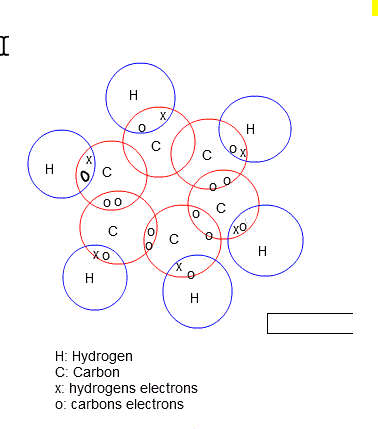
It is formed by two harmless elements: Carbon and Hydrogen.

1.31 Carbon

Carbon has an atomic number of 6, and a mass number of 12. It is a harmless, non metallic element and is the fourth most abundant element in the universe (hydrogen, helium, and oxygen are found in higher amounts, by mass).

1.32 Hydrogen

Hydrogen has the atomic number of 1, a mass number of 1, and is the first element of the periodic table. It takes up 75% of the universe. However, it is relatively rare on earth. Hydrogen is extremely flammable, and is always associated with the famous explosion of the Hindenburg airship.

1.4 Harmful aspects of benzene

1.41 Overview

Benzene exposure has serious health effects. The American Petroleum Institute stated in 1948 that "it is generally considered that the only absolutely safe concentration for benzene is zero." The US Department of Health and Human Services classifies benzene as a human carcinogen.

1.42 Short term effects

The short-term breathing of high levels of benzene can result in death; low levels can cause drowsiness, dizziness, rapid heart rate, headaches, tremors, confusion, and unconsciousness. Eating or drinking foods containing high levels of benzene can cause vomiting, irritation of the stomach, dizziness, sleepiness, convulsions, and death.

1.43 Long Term effects

Long-term exposure to excessive levels of benzene in the air causes leukemia, a potentially fatal cancer of the blood-forming organs, in susceptible individuals.

LSS- online learning (Mark Soh)


This is carbon monoxide. It is made up of 2 harmless elements, one atom of carbon and one atom of oxide. This results in carbon monoxide.
Carbon monoxide is a colourless, odorless and tastless gas that is slightly lighter than air. It is toxic to humans and animals in large amounts.
This compound in bonded through covalent bonding as both carbon and oxide are non-metals.

Carbon: Carbon is a naturally abundant nonmetallic element which forms the basis of most living organisms. Carbon is the fourth most abundant element in the universe, and it plays a crucial role in the health and stability of the planet through the carbon cycle.
Oxide:An oxide is an anion of oxygen in the oxidation state of -2 or a chemical compound formally containing an oxygen in this state. Most of the Earth's crust consists of oxides. Oxides result when elements are oxidized by oxygen in air.
Formation: In carbon, it is four electrons away from becoming a noble gas and oxide is two short from becoming a noble gas. Hence a coordinate covalent bond is formed and carbon monoxide is formed.

Dot and cross: Above

References: www.wikipedia.com
www.wisegeek.com

Online Lesson


Ammonia
Ammonia is a compound of nitrogen and hydrogen with the formula NH3. Both nitrogen and hydrogen are harmless gases that we breathe in everyday but ammonia is both caustic and hazardous. It is also a colourless gas with a pungent odour. It is produced by the decaying process of plants and animals, it is also found in small quantities in rainwater. It is lighter than air, its density being 0.589 times that of air. It is easily liquefied due to the strong hydrogen bonding between molecules; the liquid boils at −33.3 °C, and solidifies at −77.7 °C to white crystals. Ammonia does not burn readily or sustain combustion.

The type of chemical bonding involved is covalent bonds as nitrogen and hydrogen are non-metals, so the there are 3 hydrogen atoms to share their only electron with 1 nitrogen atom to become stable. Ammonia is manufactured by the reaction of hydrogen with nitrogen in the presence of an iron catalyst, which is known as the Haber-Bosch process.

Nitrogen is a chemical element that has the symbol N, atomic number of 7 and atomic mass 14.It is a colourless, odourless and tasteless gas that takes up 78% of the volume of the Earth’s atmosphere and 75% by weight in Earth’s atmosphere. Hydrogen is the chemical element with atomic number 1. It is represented by the symbol H, with an average atomic weight of 1. It is the lightest and the most abundant element in the universe.
Dot and cross diagram (See above)

Done by: Dong Dexin(11) 2A2


Reference:
http://en.labs.wikimedia.org/wiki/A-level_Chemistry/OCR_(Salters)/Molecular_geometry
http://en.wikipedia.org/wiki/Ammonia
http://en.wikipedia.org/wiki/Nitrogen
http://en.wikipedia.org/wiki/Hydrogen

Wednesday, February 9, 2011

A harmful compound(By Kenneth Neoh)

Harmful compound sulfur dioxide (SO4)

Harmless constituent elements: Oxygen(O) and Sulfur(S)

Why is it harmful: Breathing in this gas might cause breathing problems and respiratory diseases. Might also cause premature death.

Chemical Bonding: Covalent Bonding

Constituent elements:

Sulfur: Atomic number 16, a non-metallic element that is yellow in colour. It is essential for life and found in 2 amino acids, cysteine and methiodine. Used mostly as fetilizers if not gunpowder pesticides etc.

Oxygen:Atomic number 8, non-metallic gas which is found colourless in gaseous state and pale blue in liquid state. It consists of 20.8% of the atmosphere in earth and is highly reactive, thus making it form compounds with almost any other element readily.

Sulfur dioxide: Formed by burning sulfur, which is bonding oxygen with sulfur through covalent bonding.

Dot and cross diagram:

Pleasant reminder...

The admin have noticed that Jason had used Wen Yangs account to do his posting. This is TOTALLY unacceptable. Jason, save your work on a word document, and post it using YOUR OWN account. Thanks. Also, the admin would like to remind 2A2 to hand in their work puntually by Valentines day.

The Admin

Carbon monoxide (ethan's work)


Carbon monoxide:

Carbon monoxide is a harmful compound which consists of two harmless elements. The two harmless elements are carbon and oxygen so that is why Carbon monoxide's symbol is "CO".

Constituent elements:
Carbon--- it is nonmetallic and tetravalent which makes four electrons available to form covalent chemical bonds. Carbon, in all forms, are very stable and this is why it requires high temperature to react with oxygen to form CO. It is the 15th most abundant element in the earth's crust and is present in all lifeforms like human bodies.

Oxygen---it is a member of the chalcogen group on the periodic table and is highly reactive which readily forms compounds with almost all other elements in the periodic table. Oxygen, is also colorless, odorless and tasteless and is needed for living things to survive. It is the third most abundant element in the earth's crust and was discovered in 1773 or earlier.

Formation:
Carbon and oxygen is connected by a triple bond. This bond consists of two covalent bonds and one dative covalent bond. Covalent bond is a form of chemical bonding where elements share electrons between each other. Carbon has 4 electrons while oxygen has only 6 electrons. This shows that they do not have a full outer valence shell so they have to share electrons. In the end, after the two elements share electrons and have full valence shells making the element stable and forming a new compound.

Dot and cross diagram: LOOK ABOVE

Sources:
http://en.wikipedia.org/wiki/Carbon_monoxide
http://sixthsense.osfc.ac.uk/chemistry/bonding/covalent.asp
http://en.wikipedia.org/wiki/Oxygen
http://en.wikipedia.org/wiki/Carbon
Google

Done by: Ethan Teo (12) 2a2


The harmful compound that I identified is carbon monoxide. It is formed by covalent bonding.
Carbon monoxide is produced from the partial oxidation of carbon-containing compounds; it forms when there is not enough oxygen to produce carbon dioxide (CO2), such as when operating a stove or an internal combustion engine in an enclosed space.Carbon monoxide is produced from the partial oxidation of carbon-containing compounds; it forms when there is not enough oxygen to produce carbon dioxide (CO2), such as when operating a stove or an internal combustion engine in an enclosed space.
Carbon is nonmetallic and tetravalent—making four electrons available to form covalent chemical bonds.Oxygen is a member of the chalcogen group on the periodic table, and is a highly reactive nonmetallic element that readily forms compounds (notably oxides) with almost all other elements.